Wednesday, January 23, 2013

Good Enough for Green: GreenFaith Fellowship first retreat report-back

I was pleased to be sponsored by Westtown School in my application to the GreenFaith Fellowship Program, and upon hearing of my acceptance, was at once excited and had trepidations about being part of a program with ordained clergy. As a Friend who attended an Episcopal seminary, I had the good luck of having fellow Quaker students in my cohort, and the willingness to engage with larger questions of church and justice in a broader Christian landscape.  Learning and leading with fellow travelers who were seeking ordination, I gained an appreciation and respect for those called to lead in congregations, and confirmation in my belief in the priesthood of all, the lack of laity that is at the heart of Friends’ faith.
I should not have been worried with engaging with clergy again. Having just completed the first of three retreats that are part of this program, I can safely say that those called to save our planet through the lens of diverse faiths know that what is at stake is reaching out across faith differences, and committing with whole heart to this shared challenge that our faiths call to us.
This program spans 18 months, includes three face-to-face retreats, and monthly webinars. We write eco-autobiographies, theological research from our faith traditions, and plan and implement leadership projects. This program will offer me space to engage theologically with the ecological and justice commitments that motivate me in my work.
GreenFaith’s mission is “to inspire, educate and mobilize people of diverse religious backgrounds for environmental leadership.  Our work is based on beliefs shared by the world’s great religions - we believe that protecting the earth is a religious value, and that environmental stewardship is a moral responsibility.” (greenfaith.org/about/) This first retreat, focused on stewardship, offered many insights into the diversity of faiths represented, and our common cause of catalyzing our communities for bold faithful environmental work. Muslim, Buddhist, Christian, Hindu, Atheist, Catholic, Episcopal, United  Church of Christ, Baptist, New Church Movement, Lutheran Fellows  were represented from around the USA and Canada—and one Fellow from Finland! It was truly an inspiring and challenging event. 
At the retreat, we met in year cohorts. I am a member of the 2013 cohort, and the 2012 cohort was having their last retreat with us. Although I was the only Friend in attendance, we had ample opportunity to engage Friends values, as we convened at Pendle Hill, and one of our site visits was to the Friends Center to hear about the process and results of the greening of that building. We also toured a green jobs training center in the Kensington neighborhood of Philadelphia, and participated in green site audits at a local Presbyterian Church, and synagogue.
It was exciting to hear about the leadership projects that the 2012 fellows are doing. From liturgical music with earth care themes, to lunchtime discussions in faith communities, to online interfaith organizing, to programming on the regional and national level, these fellows modeled the strategic and systematic thinking needed to bring the good word of our environmental moment to communities still unsure of what to do, or how to do it from grounding in faith.
Our next retreat, in May, is at a Buddhist retreat in upstate New York, and the theme is Spirit. We will be surrounded by beauty, and have the chance to hike and reflect on the deep well of our faiths. I cannot wait to see what work becomes clear for me as I embrace my call to be good enough for the greening of our planet and faiths.  I look forward to further reflection and growth with this dynamic program, and the openings that will occur in me as I continue my faithful pursuit of integration of my sense of ministry with the work of the land.
all photos thanks to Jamaal Reavis

Monday, January 14, 2013

Full Circle

I am at Pendle Hill for a retreat on environmental stewardship for religious leaders.  I get to spend three nights in this lovely holy place with religious leaders from many faiths-- Christian, Muslim, Hindu, Jewish, Buddhist, Catholic-- learning and teaching together from our diverse locations. I am a member of the 2013 GreenFaith Fellowship Program, and I am thrilled to be back at Pendle Hill.

If you don't know Pendle Hill, it's a Quaker retreat, conference, and study center on 24 acres in Wallingford, PA. Folks come for conferences, to study, to do art, to be among Friends.  It's also where I have had some of my greatest spiritual growth. 
me in 2002 at Pendle Hill

I came here first as a student in 1997, for a term in the spring, as a resident student. I then returned in summer of 1999 to be a summer staffer in between my second and third year of seminary. And again, and finally my last return to Pendle Hill was in 2001, to be a seasoned Social Action Social Witness intern, sharing my skills with the community and engaging in non-violence training in prison and community with the Alternatives to Violence Project. I learned bio-intensive gardening here, and worked in the bookstore. I left that work in 2003. 

Pendle Hill is a type of home for me.  A home I left a decade ago and only recently started returning to, now with a child, a partner, a life apart from this place that for quite awhile seemed like the place I was meant to come back to, someday. Come back to stay. Come back to be in community, to live, to grow old and die here. 
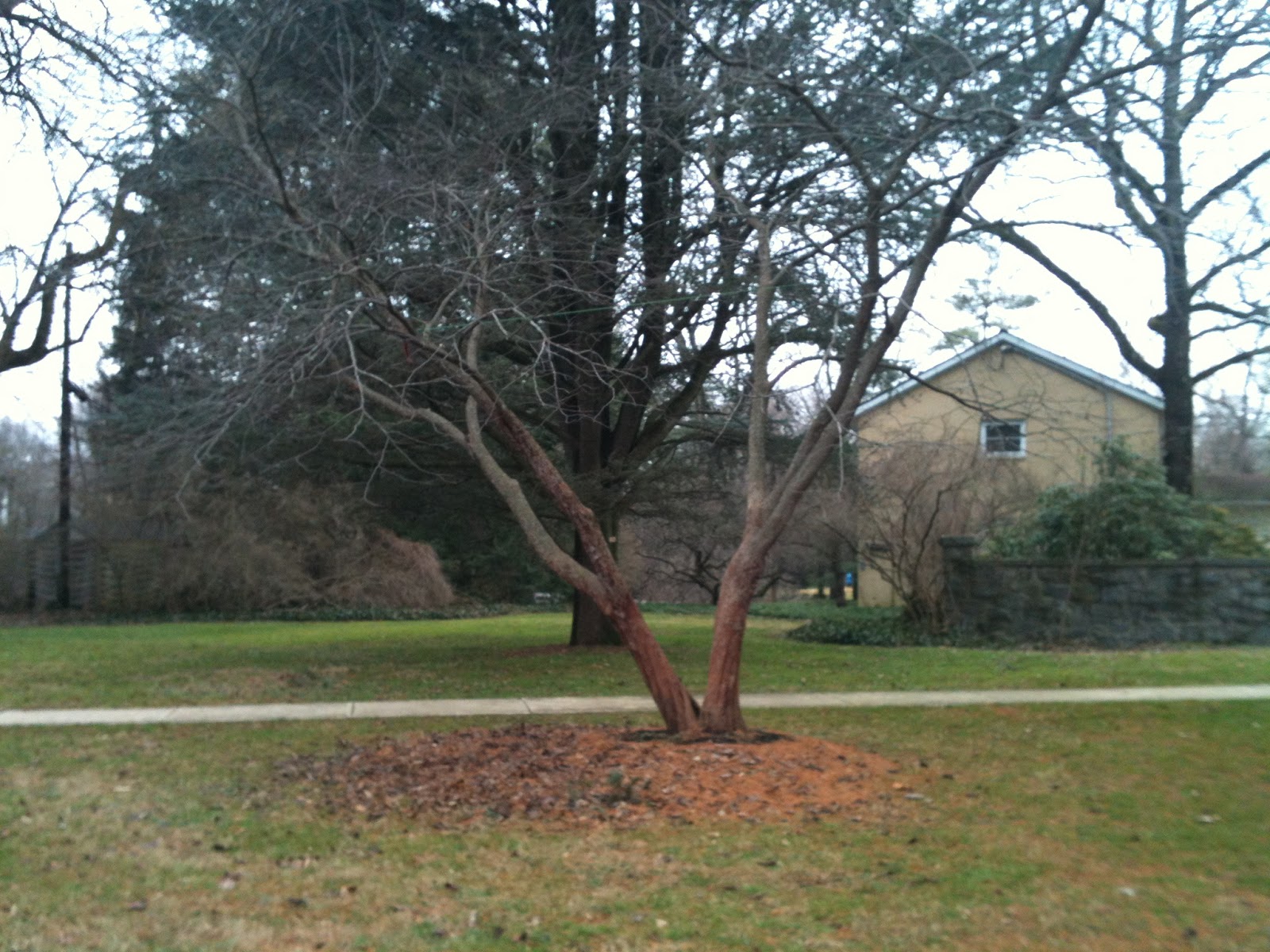
This tree was planted in spring 1997 in honor of Wilf Howarth,
at the rise of my first meeting for worship at Pendle Hill. 

This returning, however, is different than I had once imagined. This returning is to a place that holds so much memory, is full of nostalgia and meaning. The space where we are meeting, even this space has many memories-- frenetic drumming circles raising me to crazy heights on a hot June night, meeting Vincent and Rosemarie Harding and their Veterans of Hope elders, experiencing deep healing around the hurts of racism and homophobia with Niyonu Spann in her Beyond Diversity 101 workshop, cleaning bathrooms and making beds as part of my summer housekeeping job with beloved Charlotte and Alison, doing dishes and serving food as a work exchange student with the charismatic Sonya, Costa Rican Quaker chef, teacher, folksinger, friend. All of this happened to me here, in this space where I am writing right now. And there is more that will surface over the next days. And I am ready for it. 

Even the art in this room is made by the amazing Melanie Weidner who I knew when she was here as an arts scholar. I feel like everything here has a person's face connected with it, a beloved face that I cannot keep with me when I am not here. Each memory is a gift.

Now I am seeing that I am living a full circle. I have returned here to be confirmed in my vision for the life and work in my heart. I feel as if I have arrived back where I began, at a place of need and being met in my need, in a place that has much to give. And this returning is telling me that it is time to jump off this wheel, into the blessed unknown of vision and seeking space for that vision. 

This is a post of gratitude for the deep stream that is carrying me, whether or not I recognize it. This deep stream carries these memories, these faces, the souls who have traveled along, for awhile, and touched my life. Here's a moment where I can see the stream clearly, eddying around my feet, calling me on, and downstream, further along this beloved path. Thank you. Thank you. Thank you. 

Saturday, January 12, 2013

Come Unity

I just came back from a small gathering of Friends in a home, a reunion of the Called to Action 2012 group of which I was a member. This group met monthly for six months for day long workshops led by elders in Friends and movement settings, bringing the good word of integrated spirituality in activism, and strategic organizing as a vehicle of God's grace. 

It was pretty amazing. Many folks were laid low with flu, so that was sad. But among we who could make it,  what we came to, as we worshipped, ate, reflected, settled in together, was a full circle of what one Friend called the mobius strip of activism, the union of the inner and the outer journey that we strove to articulate and embrace in our time together as teachers and learners. 

At one point in the evening, we were discussing loneliness. A number of us shared in some way that loneliness had touched us, and how the convention of gossip and idle chatter were not comfortable for us. I sort of blurted out; "That's why I could never be a priest in a church-- coffee hour. Leading and sharing a deep spiritual experience and then going and drinking coffee afterwards-- that's my definition of a circle of hell. That's what's different about Friends: we are all priests, and so the burden of priesthood is not so heavy when we are all carrying it. It makes coffee hour a bit easier for me." 

This is the gift of Friends, the gift that I find unique and truly Quakerly. It's not owned by Friends, it appears in other faiths, as well-- the sense that we are all called, or could be so, to minister. But this truth is most lived, in my experience, among Friends. And because of this potential, this spark of Spirit in each of us, we all share the burden, the weighty role of holding worship, being the containers of our shared and disparate faith. 

I've traveled in a number of faith traditions, and tried to make my faith fit into those communities. But it is only among Friends that I have found this radical belief in the end of laity-- the true Society of Friends, where we are all potentially charged with the gifts of the Spirit. This I feel more lived among Friends than any other setting I've been in. And so, I am a Quaker.

This speaks to the possibility of continuing revelation. This practice and belief requires of Friends a faith that is strong and openly risking a diffuse and diverse truth! No wonder we look to our histories to give us lived examples of how to handle this hot, uncertain, risky hope. 

Some Friends speak recently of the need to be "ready to die to Quakerism so that the gospel Friends proclaim may find fullest expression." I think, more, that we need to truly live into this Quaker-ism, this mindset and worldview. Not the formalism of correct language, or idolatry of the past (which I will say I have not seen in the main in my experience among Friends), but the event of Friendship, if I can describe it thus.

We need the willingness to wait upon the Spirit, in the diverse ways we are led to do so, and minister to each other, in love and truth. Calls to die to a shared faith community smack of the wearing of hair shirts or the bizarre view that self-harm leads to sanctification. We do not help anyone, least of all the bringing of the kin-dom, through inflicting threats of dispersal and rejection of practices deeply rooted in the gospel. I believe that this shared and disparate faith tradition can move all of us closer to God, without exception or condition. It doesn't look like anything we know, but I have seen small glimmers, like at our dinner table tonight. And I know this experimentally.


Wednesday, December 26, 2012

The Devil Inside

I am aware that naming evil is not enough. I am aware that my mind shies away from thinking about the tasks of working with it, healing it, defeating it. The post by Nancy Reeves, Two Flowers in the Sanctuary and #28 Acts, requires that I engage further. 

The risk of using the word evil is that it distances, it makes it seem foreign, alien, something so caustic and disgusting that it defies address or redress. How can we agree with the assessment and evil and do anything but run? 


I refuse to run. Though I am spurred to the door, to the high cliff-- the lonely high cliff of the moral high ground, as I am reminded by my dear sister-in-law-- by calling out evil, it does no good at all for the world. I remember well the prayer of my youth-- Do you reject Satan and all of his works, all of his empty promises? I do. I want to. But what a fabulously un-nuanced understanding of evil, this horned progenitor of all that sickens, wilts, destroys! What an easy easy thing to move away, to stamp out, to sequester and shun!

This reminds me of my own rejections, reminds me of the persistent belief in myself that I am sick, wrong. This reminds me of the numbness of getting kicked to the curb as a teen for my queer love. Who was evil, then? The family who rejected, or the freakish desire rising in me like so much thorny invader on the quiet landscape of my heterosexual family? When we see evil as something outside of our human community, and therefore outside of our responsibility, then the risk of splitting raises its terrible head. 

For who does not desire the gun? For who does not harbor the murderer in their heart? For who does not ache the lonely moment before despair? For who does not reject the uncomfortable, the odd? For who lives wide open, with love only, with hope only, with good only?

If I reject the evil in the acts of war, in the acts of massacre, as something that does not rest in a part of me, something that does not live in my human potential, then I am losing my own humanity. I am losing the chance for compassion, for vulnerable love, for heart-changing growth. Is it not the revolution of free will that spurs us to greatness? Is it not my own ability to choose life that gives it value? 

When we split ourselves off from these (I'll call them negative) parts of ourselves, all kinds of f-ed up stuff happens, not least of which is the roots of our most pernicious ills-- beliefs, actions, policies that support a view that those people are the one's with the problems, and the unhappy result that usually those people are the non-dominant, the non-white, non-male, non-Christian, non-owning class, etc. etc.  Racism, sexism, heterosexism-- these ideas that somehow there is a class of less than human, where all of these sentiments rest, is the result of the mind of the split consciousness. 

So, for myself, I am looking for a better answer to the impulse of the gun in me. I am looking for a way to hold an understanding of evil that does not condemn me, or condemn my neighbor. As a Quaker, I hold that there is that-of-God in everyone. I also hold that there is that of evil in everyone. It is in this human potential that I find the most awe, and so much sadness. But if I think that I cannot hold all of this in my understanding of human, than I perpetrate a deep injustice, and risk missing the joy of what true healing and community can be.

So let us practice our 28 mitzvahs, kind acts, remembrances for all of those who died. For all of those potentials that were never expressed, or that were. Our mourning is large, and should be larger. Let us truly see each other as the full humans we are, and let us love one another and ourselves for our dance and struggles with evil. We can reach the other side of those struggles, where love wins and we end the splitting of self that allows evil to flourish. For this, I pray.

Amen.

Wednesday, December 19, 2012

Naming the Unnamable

The massacre in CT, Westboro Baptist Church's plan to picket children's funerals, disparate reactions to children's deaths near and far-- this giant snowball of pain and sickness leads me to name what is really difficult for me to name. 

On Friday, after half-listening to the stories, seeing flashes of headline, but not really wanting to hear, I grabbed from my bookshelf, People of the Lie, by M. Scott Peck. This book, published in the 1980s, describes through anecdote a religious and psychological understanding of the lives of those suffering with malignant narcissism. The half-heard stories of Adam Lanza using his mother's guns to kill her and the children and adults at the school, reminded me of a stark story from the book. 


As a therapist, Peck saw a boy who had stolen a car and run it off the road. He was mandated by the courts to have a psychological evaluation. Peck met with the boy, and came to understand that his brother had recently killed himself with a shotgun. It was after the New Year, and as Peck tried to connect with the boy, he asked about any Christmas presents he had received. What he discovers is that the boy's parents had given him the same gun his brother had used to kill himself as a Christmas gift. 

This information immediately spurred in Peck the plan to get the son away from the parents. Peck had the chance to ask the parents about the choice of gift, and the parents deny completely any wrongdoing, any message of sadism or encouragement to death. They say that a gun is a good gift, and they didn't have enough money to get a new one for their son. They say that that they don't see anything wrong with giving a perfectly good gun to their son. They are blind to their own destructiveness. They are. Evil. 

So I've written it. Evil. As a religious and spiritual feminist liberationist, I have resisted an understanding of evil that rests in the individual. I see structural evil, I see how it can act out in the lives of individuals, but I have for many years avoided looking to individuals as being evil. 

We are truly all standing in a stream of social location, cultural tide, worlds of meaning working through us in our lives. So many of the posts analyzing mental illness around the massacre (I am Adam Lanza's mother), as well as the racism inherent in the description of Lanza as mentally ill (were he brown, he would more likely be called a terrorist), speak to this deep tide of our connectedness. And all of these pieces are true, to some degree. 

What is real to me, as I mix all this soup together, is that there is something evil here. It's not just sickness, it's not just structural evil of racism and alienation of the mentally ill. It's something about the proliferation of guns, the sharing of guns across the generations, the use of the mother's guns by the son, that echoes for me the deep evil of generational malignant and sadistic narcissism. 

He killed himself, Lanza did, after taking so many with him. Was he thinking of his mother as he took the guns they had shared in target practice together, months before? Was he thinking of the message of these shared guns? What sickness in him is an expression of the message of the gun-- the death dealing machine that came from his mother's proverbial milk? What is the consequence of drinking this poison?  

I don't have answers to any of these questions. What I am left with, as I chew and chew, is that I am sickened by these stories, these true stories. I have the strength now to say what these acts and individuals are enacting, and it's evil. 

My questions are to those who are standing at the entryway to the next generation-- we parents. How long can the child resist incitation to violence? How long until we end this lineage of death?  How will we set our children free from this heritage of impunity and destruction, and the lessons of worthlessness that our violence and narcissism teaches our children? I know I will resist this destruction with all of my will and love. Let us resist this evil of seeing our children as less than ourselves, and honor the life that is seeking expression in them. 

Tuesday, December 11, 2012

Passing

Things are heavy here in our household right now. A much beloved uncle died yesterday, after what feels like a long battle with cancer. He died in the morning, while with his now adult children and wife. My partner traveled up to be with him last week, and got to see him on one of his last lucid days. 


It wasn't an easy decision for my partner to go up to Vermont, leaving his work as a teacher, leaving me at home alone with the little (now 2 1/2 yo) f. After the word came that hospice was suggested by his doctor, a day passed, with all its vicissitudes and stressors. That evening, once little f was asleep, my partner and I met in the kitchen. 

"Have you thought about going up to see Spike?" I asked. 

"It's been rolling around in my mind today, I'm still thinking about it."

"Would you like my opinion on the matter?"

As soon as I got the yes, I didn't stop for a moment. Go. I said go. Go. Go. Go. Do not pass go, do not collect $200. Do not stop to wonder. Do not question if you are wanted. Do not let your fears stop you. Do not think it's too much time to take off. Do not worry about your son, or your beloved. Do not worry about the timing. Do not worry about the cost. Just go. Go. Go. 

I am glad to say that N did not leave that evening. He made the good choice of checking in with all concerned, and traveled up with his parents for a timely visit and farewell. I was solo parenting for three nights. It was absolutely worth it. 


As someone who is pretty damn certain that having a baby was one of the most transformative events in my life, I am also equally certain that the other end has the potential to be the same. We all get to choose how we relate to these transformative times, and to me, the worst thing to do is to pass up a chance to touch into the love and connection that is at the center of life. There is so much that urges us away from that closeness. And all of that is a lie and a hoodwink. We deserve to be close to life. We just do. Without reservation. We all deserve it.

I was with my grandfather on the day he died. I won't describe in detail what happened, mostly to protect those in my family who were there, as well. But what I will describe is my experience of sitting by his bedside, where he had decided to be at the end, and closing my eyes. I don't know how to name what impulse moved me, but I was suddenly holding in my mind each of the points on my grandfather's body that held energy. As I imagined them, I urged them in my mind to release. I was crying, I know. I was scared. And when he died later that day, it felt very right. Very real and very right. 

As I read this, I think I sound like a hippy freak. And as you know from a previous post, I am not a hippie. What I am is a deeply spiritual person. And how did I learn this? I just can't tell you right now. Right now what I know is that there is something in this life that wants us to get close. And sometimes it takes these transforming times-- birth and death, loss, trauma, injustice, love, justice, ritual, other stuff-- art, revolutions, nature, lotsa stuff-- to shake us into that awareness. I'm trying to hold onto the loss of this good good man as an invitation to the closeness of life. I'm not quite there, but writing it helps. 

Spike, in the five or so years I knew him, was a New England gentleman cum conspiracy theorist cum tractor savior cum father cum intellectual cum gracious host cum welcome wagon. I felt his hugs in my feet, and was always just a wee bit scared of him. As the cancer brought him to a more remote orbit, I was always amazed at his comfort with just disappearing. No words, just gone for whatever reason was motivating him at a family gathering. As his energy shifted, I felt a clarity in his eyes, rather than saw it. The refining fire of treatment, spiritual and modern, meant that he was living in different time than the rest of those who gathered around him. His participation was always just a gift, and one that I only benefitted from by default. Lucky me. 


So this is to Spike's passing. So this is to our growing closer. So this is to saying yes, and go, and more, please. We deserve this life. All parts of it. Even when we don't, and even when it's hard as hell. We deserve to be close, and to find it in each step, from beginning to end. 

Tuesday, November 27, 2012

Martyrs and Clowns

Today I am seeing reminders of the loss of two great men in the causes of gay rights and peace-- Harvey Milk and Tom Fox. In 2005 on this date, Tom Fox was abducted while doing peace work in Baghdad. He was found dead months later. In 1978, Harvey Milk was gunned down in San Francisco for the sole reason of his public and political gayness. 

Both of these men and their movements have figured prominently in my understanding of myself as a queer person of Quaker faith seeking justice and safety in my life and the lives of my fellow humans on this planet. Both of these men stand for me as examples of what the natural extension of the work of witness and truth telling can be. Yup, it's death. We speak truth to power, we could die. 

When I was a kid, I had a personal relationship with a Jesus who I knew had died for me. He was my intimate imaginary friend. He was my externalized conscience. And, as I learned more about him in Catholic school, at mass and in conversations with my mother, he was my true savior. Without him, how could I be? And could I ever be him? Would I want to be? Was I good enough? Usually, the answer was no. 

These modern day martyrs echo that feeling for me. Are these men inspiring to me? Cautionary? Daunting? All of these, and more, maybe. It is the death of the privileged in the work of justice-love, the visible, the front and center, that makes for our common understanding of martyr.  And these voices, bodies, risk-takers, wily spirits in the world go far toward this justice-love they so seek. They are beacons and calls to us, they demand a response from we more comfortable, we less willing to risk for what we believe. They are, so I can be in this world, now.

Beside this, I have been seeing some really overwhelming examples of creative actions done by groups that shock, amaze, impress, and make me laugh. The stuff that's reaching me as I make my way around the interwebs is brilliant: naked ACT UP occupiers, clowns against Nazis, men in heels, singing civil disobedience. All of this makes me feel like I could be a part of this bigness, this creative hullabaloo.  Check it out: Walk a Mile in Her Shoes


Clown Protest at KKK Rally


Occupy Homes Singing Protest
image from NYT article

You can't make this stuff up, and I wouldn't want to. These actions give me so much hope, and give me a model of action and change I can work with. I am not meant to be a martyr. I am meant to survive and survive. And thrive, if I'm lucky. These clowns for the cause, these holy laugh a minute rollers, who speak to our better natures through inspiring risks of playful honesty bring out a whole different level of awe in me. Are they daunting? Inspiring? Invigorating? All those, and more. And could I be one of these multitude of jesters, tricksters, subverters? Perhaps the answer is, yes.

We need our clowns and martyrs, and we need to know that they can be all of us. Clowns can die, too. Martyrs can rise again. I am glad to be reminded today of the many faces of this arch and muddle toward justice, and the many paths leading toward justice-love.